Posts

Showing posts with the label Asteroids

This Breathtaking Photo of Earth From 40 Million Miles Away Really Puts Everything Into Perspective

Image
👋 Wave hello to yourself! NASA’s OSIRIS-REx spacecraft captured this image of the Earth and Moon on January 17 from a distance of 39.5 million miles. It's been an incompatible few months on this blue dot of ours, but nothing puts life into perception like this amazing photo captured by a spacecraft literally millions of miles from us. Image Credit: NASA NASA’s OSIRIS-REx, an asteroid-sampling spacecraft, captured the image below as portion of an engineering test on January 17 2018. The probe was stirring away from us at about 8.5 km per second (19,000 miles per hour) when it captured the photo - snapping a minute Earth and Moon sitting together 63.6 million kilometers (39.5 million miles) away from us. In the photo, you can see Earth is the perky dot in the mid of the image, and the Moon is the minor dot to the right. But if you look a little closely, there's way much more to haze upon in the background. As NASA explains , "Several constellations are also visible in ...

We've Finally Got A Decent Look At Earth's New Moon

Image
Just last year , researchers observed 2016 HO3, a satellite of our planet. And now new and more comprehensive observations, displayed at the Annual Division for Planetary Sciences Meeting, have now verified that the object is certainly a piece of rock with unknown origin but certainly not a bit of space junk. The orbit of 2016 HO3, around the Earth and the Sun. NASA/JPL-Caltech The path of 2016 HO3 is strange, to say the least. It circles the Sun, and also orbits our Earth, moving between 38 and 100 times the distance between our planet and the Moon. So it’s quiet close enough to make its origin complex but a bit too far to be studied in detail. To understand 2016 HO3, Assistant Professor Vishnu Reddy and his team from the University of Arizona decided to perform some ad hoc observations during a close approach. The team wasn’t able to constrain its size – which is definitely no larger than 100 meters (330 feet) – but could tell that it rotates on its axis twice in an hour and reflects...

Mind-Blowing: There is a 2 BILLION-Year-Old Natural Nuclear Reactor in Africa

Image
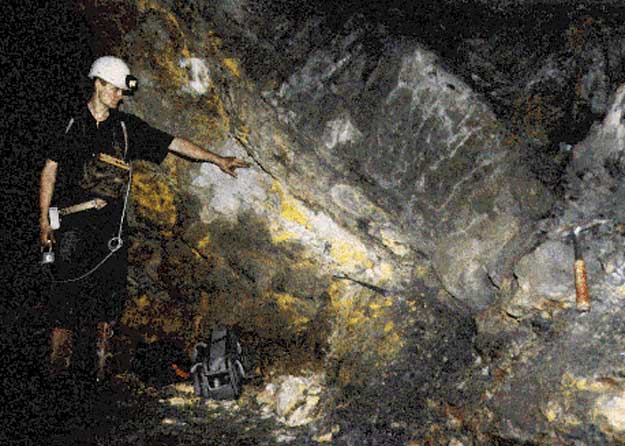
An ancient natural nuclear reactor that was churning away nearly 2 billion years ago sounds like a made-up myth. Perhaps it's because the word reactor suggests a manmade structure. Instead, the reactor is an area of natural uranium inside the Earth's crust, detected in Okla, Gabon. Uranium is naturally radioactive, and the settings in this rocky area happened to be just accurate to do some nuclear reactions.  The natural reactor must have annoyed nuclear scientists: The first nuclear reactor to provide electricity was build up in 1951, and this only made a small amount of energy. The pile of rock in the ground in Okla, instead, had generated nuclear power around 2 billion years ago! Oklo: Ancient African Nuclear Reactors It was discovered in  1972 , when some French scientists took uranium ore from the mine in Gabon to test its uranium content. Typically, uranium ore is made up of three types (isotopes) of uranium, each one with a different number of neutrons: U...

Astronomers Have Revealed The Biggest Meteor Shower Ever Recorded In The Solar System

Image
On our planet, we’re quite in luck if we see a few hundred meteors an hour during a meteor shower. But if you were on Mars about three years ago, nevertheless, you would have witnessed something extraordinary – 108,000 meteors per hour, the biggest meteor shower ever in recorded history on any planet. This meteor shower was a result of Comet C/2013 A1 (Siding Spring) zipping past the planet on October 19, 2014. We were lucky to have a spacecraft in circling the planet back then, and what they observed was unbelievable.  Observations from the event were offered few days ago at the European Planetary Science Congress (EPSC) 2017 in Riga, Latvia. Dr Beatriz Sanchez-Cano from the University of Leicester, who co-presented the findings, said “This is one of the most exciting planetary events that we’ll see in our lifetime. Mars was literally engulfed by the coma, the comet’s outer atmosphere, for several hours.” Siding Spring flew past Mars at a distance of 140,000 kilometers (87,000 mi...

16 Mind-Blowing Facts About The Universe

Image
Here are some truly amazing facts about Universe that you probably didn’t know before. Watch the video below:

This One Gif Is Better Than Anything Else You'll See Today

Image
This Gif is the best and there is no better than this on internet. Not even your cats or dogs videos. You are wondering what is it exactly. Well it is next target for NASA’s New Horizons mission. A small rock in the outer skirts of our solar system, passed in front of a star as seen from Earth. The event in the early morning of July 17 lasted a split-second, but it will give us more information about this rock than we’ve ever gleaned before. All from the shadow that was cast over our planet. “It was the most historic occultation on the face of the Earth,” NASA’s director of planetary science, Jim Green, told the team in a statement. The Kuiper Belt Object (KBO) is called 2014 MU69. It measures roughly 22 to 40 kilometers (14 to 25 miles) across, but we don’t know for sure because it’s so far away and faint. It orbits 40 times further from the Sun than Earth. We also don’t really know what it looks like. It’s thought to be a leftover from the formation of our Solar System about 4.6 bill...

Astronomers Finally Know How Old Jupiter Is

Image
Astronomers have finally figure out how old Jupiter is. According to a recent study , the gas giant's main core had already grown to be 20 times more massive than Earth just 1 million years after the sun formed. Lead author of this study, Thomas Kruijer, of the University of Munster in Germany and Lawrence Livermore National Laboratory in California, said in a statement : "Jupiter is the oldest planet of the solar system, and its solid core formed well before the solar nebula gas dissipated, consistent with the core-accretion model for giant planet formation," Jupiter is not only the largest planet in our solar system, but it’s also the oldest, according to a new study. Credit: NASA Some 4.6 billion years ago, the solar system coalesced from an enormous cloud of gas and dust. The sun formed first, and the planets then accreted from the leftover material spinning around the newborn star in a vast disc. Theoretical work powerfully proposes that Jupiter took form pretty earl...

Asteroid Warning: NASA Discovers Ten ‘Potentially Hazardous’ Rocks Close To Earth

Image
NASA has been working determinedly to find dangers that Earth face from space, and has said that it has discovered 10 new asteroids which it considers could damage life on Earth. This vital discovery was made by NASA’s asteroid identifying mission – Near-Earth Object Wide-field Infrared Survey Explorer or NEOWISE. Amy Mainzer, NEOWISE main researcher from NASA’s Jet Propulsion Laboratory in Pasadena, California, said :  “NEOWISE is not only discovering previously uncharted asteroids and comets, but it is providing excellent data on many of those already in our catalog. It is also proving to be an invaluable tool in in the refining and perfecting of techniques for near-Earth object discovery and characterization by a space-based infrared observatory.” On top of the 10 “potentially hazardous” objects, NASA says that they have discovered 97 others pace rocks and observed a baffling spike in comet activity. Emily Kramer, a NASA Postdoctoral Program Fellow at JPL and lead author of pa...